




What to look for on the back of the box, from how much alginate is inside to how it's tested.
 Medically reviewed by Dr. James F. Lineback, MD, FCCP, board-certified physician and associate clinical professor of medicine at UC Riverside
8 min read

If you've been reading about alginate for reflux, you've probably noticed how many products now carry the word on the front of the box. Liquids, gels, chewables, and capsules all promise the same thing: a gel barrier that blocks acid from traveling into the esophagus.
The promise is real, and alginate has been studied for decades. But the products built on it aren't interchangeable. The differences show up on the back of the box, in six places worth checking.
The short version
- The alginate is what forms the barrier, so how much you get and how pure it is matter most.
- Look for an exact milligram amount of sodium alginate, USP-grade active ingredients, independent testing on every batch, and no California Prop 65 warning.
- Read the other ingredients for preservatives and artificial sweeteners, and pick a form you'll take every time.
- Khelp, HartSpan's alginate supplement, meets all six: 950 mg of Alginaid™ sodium alginate per serving, no proprietary blend, in two taste-free capsules formulated by Dr. James F. Lineback, MD, FCCP.
First, what alginate actually does
After you eat, acid collects at the top of your stomach. If the valve above it relaxes, that acid can rise into your esophagus.
Alginate is a natural fiber from brown seaweed. When it meets stomach acid, it forms a gel barrier that floats on top of your stomach contents and keeps acid where it belongs. You'll often see carbonates, like calcium carbonate or sodium bicarbonate, on alginate labels too. They assist the gel-barrier formation.
Because the barrier does the work, the alginate behind it matters. In lab comparisons, alginate products formed barriers that varied widely in strength depending on how they were made.1 With the rest of a formula the same, more alginate makes a stronger barrier.
Not intended to diagnose, treat, cure, or prevent any disease.
1. The exact amount of alginate
Turn the box over and find the Supplement Facts panel. You're looking for a line that reads "Sodium Alginate" with a number in milligrams next to it.
Some labels group ingredients into a "proprietary blend" or "complex" instead. When they do, the label only has to show the total weight of the blend, with the ingredients listed from most to least.2 You can see what's inside, but not how much of each, so you can't tell how much of that weight is alginate.
The Khelp standard
950 mg of Alginaid™ sodium alginate in every two-capsule serving. No proprietary blend. The exact amount of every ingredient is on the label.
2. USP-grade active ingredients
USP-grade means an ingredient meets the quality standards published by the U.S. Pharmacopeia, which check things like identity and purity.3 For a seaweed ingredient, that matters. Alginates vary with the seaweed, the extraction, and the processing, and those differences can change how strong and buoyant the barrier is.
The Khelp standard
Khelp uses Alginaid™, a trademarked, highly purified, USP-grade sodium alginate. It's specifically created for reflux and forms a strong, buoyant barrier. Every lot is tested to the USP-NF standard, and all of Khelp's active ingredients are USP-grade.
3. Independent testing on every batch
Every supplement sold in the U.S. has to be made under GMP rules, so "made in a GMP facility" is the baseline.4 It tells you how a product is made. Testing finished batches tells you whether you're getting what the label says, without contaminants.
If a brand tests every batch, it'll usually tell you, and it'll tell you what it tests for.
The Khelp standard
Every batch is tested by an independent lab for potency, purity, and heavy metals.
4. No California lead warning
California requires a Prop 65 warning when a product's maximum daily use can expose you to more than 0.5 micrograms of lead a day.5 Seaweed can carry trace minerals from the ocean, so it's worth checking any alginate product. Look on the label or product page for a line that starts with "WARNING," "CA WARNING," or "CALIFORNIA WARNING" and names lead.6
The Khelp standard
No Prop 65 warning.
5. A short list of other ingredients
Just under the Supplement Facts panel, you'll find "other ingredients." This is where liquids and gels often list sweeteners and flavors that make them pleasant to take, plus preservatives that keep them shelf-stable.
The Khelp standard
A hypromellose vegan capsule, organic rice concentrate, and bamboo extract. No preservatives, artificial sweeteners, added sugar, or flavors.
6. A form you'll take, from a physician you can name
An alginate only works if you take it as directed, after meals and before bed, night after night. So it's worth picking a form you'll stick with. Liquids and gels are measured by the spoon or packed in single-serve packets, and chewables you taste as you chew. With a capsule, it's the same two every time, and there's nothing to taste.
"I tried two other Alginate ‘barrier’ products but they were inconsistent liquids that didn't always deliver an effective dose and required refrigeration. The Khelp capsules are small and easily swallowed and travel for use after meals away from home."
It's also worth knowing who made the formula, by name.
The Khelp standard
Two taste-free vegan capsules after eating. Dr. James F. Lineback, MD, FCCP, formulated Khelp. He's a board-certified physician who has treated patients with GERD for more than 40 years. He's also an associate clinical professor of medicine at UC Riverside and our medical advisor.
Getting the most from an alginate supplement
Even a well-made alginate needs to be taken the right way. Always take Khelp after eating. Taking it before or during a meal can break up the barrier before it forms.
- At bedtime: 2 to 3 capsules after your last meal or snack, at least 30 minutes before bed. Don't eat after taking it. Thin liquids are fine.
- During the day: repeat after meals as needed, up to 9 capsules a day. For heartburn or chest tightness, start with 2 capsules and increase to 3 if symptoms persist.
- For throat symptoms (silent reflux, or LPR): start with 3 capsules before bed, and add servings after meals as needed.
Give it at least 3 weeks of consistent use before judging results. Irritated tissue takes time to settle.
Please don't stop any reflux medication suddenly. Stopping suddenly can bring a rebound of acid symptoms. Your doctor can help you taper off slowly if that's right for you.
| What to check | Where to find it | Khelp's answer |
|---|---|---|
| The exact amount of alginate | Supplement Facts panel | 950 mg sodium alginate (as Alginaid™) per serving |
| USP-grade active ingredients | Product page or label | USP-grade |
| Independent testing on every batch | Product page | Potency, purity, and heavy metals |
| No California lead warning | Label or product page | No Prop 65 warning |
| A short list of other ingredients | "Other ingredients" line | Capsule, organic rice concentrate, bamboo extract |
| A form you'll take, from a physician you can name | Directions and product page | Two taste-free capsules; Dr. James F. Lineback, MD, FCCP |
If you only check one thing
Make it the milligrams. Alginate is what forms the barrier, so the number next to "Sodium Alginate" tells you the most about what you're getting. On Khelp's label, it's 950 mg of Alginaid™ per serving.
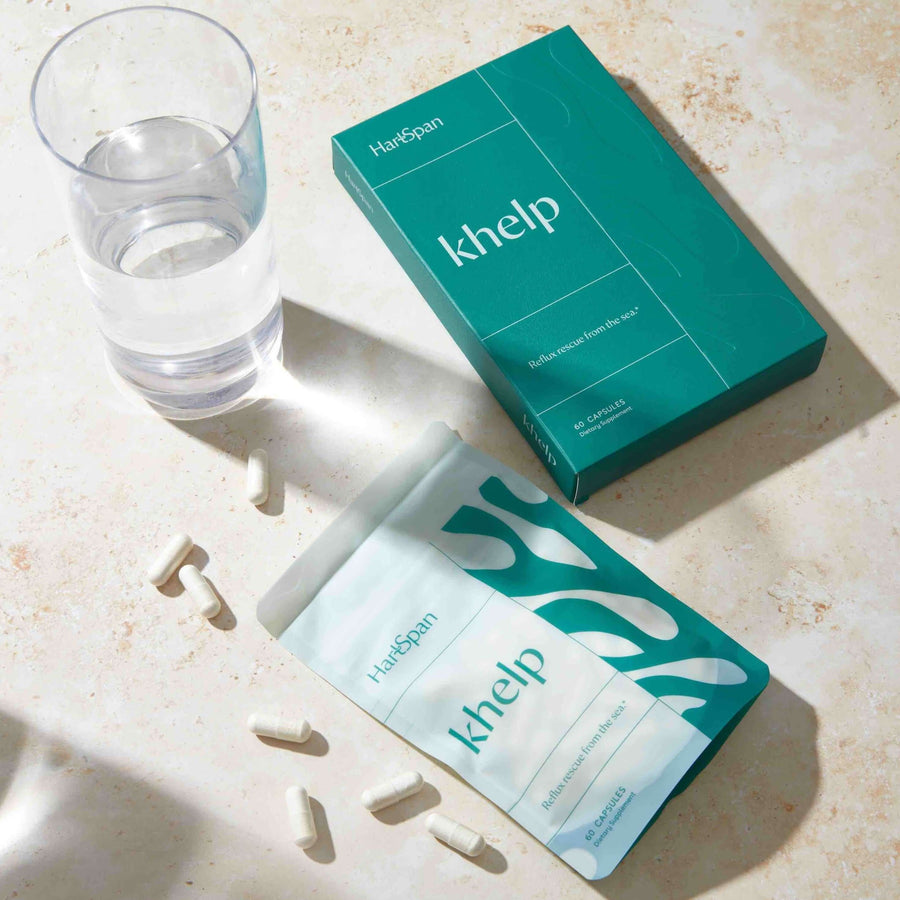
Shop the formula
Khelp
950 mg of Alginaid™ per serving. Formulated by a board-certified physician.
From $41 a pouch on the 3-month plan
Shop KhelpCommon questions
What's the best alginate supplement for acid reflux?
Look for one that lists the exact amount of sodium alginate, uses USP-grade alginate, has every batch tested by an independent lab, and carries no Prop 65 warning. Khelp meets all of these, with 950 mg of Alginaid™ sodium alginate per serving in a taste-free capsule.
What does "proprietary blend" mean on a supplement label?
It means the label shows the total weight of a group of ingredients, without the amount of each one. On an alginate supplement, that means you can't see how much alginate you're getting.
What is Alginaid™?
Alginaid™ is a trademarked, highly purified, USP-grade sodium alginate made from brown seaweed. It's specifically created for reflux and forms a strong, buoyant barrier. It's the alginate in Khelp.
Are alginate capsules as good as liquids?
Both form a gel barrier once the alginate meets stomach acid. A capsule gives you the same measured amount every time. There's nothing to taste and no spoon to measure with. Take Khelp after eating.
Why does Khelp contain calcium carbonate and sodium bicarbonate?
Calcium carbonate and sodium bicarbonate assist the gel-barrier formation. They work with the alginate so the barrier forms and floats on top of your stomach contents. Both are USP-grade, and the label lists the calcium and sodium they provide.
Does Khelp suppress stomach acid?
No. Khelp doesn't suppress or inhibit stomach acid. Its alginate forms a gel barrier on top of your stomach contents that blocks acid from traveling into your esophagus.
Is alginate safe to take every day?
Alginate has been studied for decades, with no known serious side effects in clinical research. Khelp is safe for daily use. If you have a health condition or take medication, talk with your doctor first.
Who formulated Khelp?
Dr. James F. Lineback, MD, FCCP, formulated Khelp. He's a board-certified pulmonary internist who has treated patients with GERD for more than 40 years. He's also a Fellow of the American College of Chest Physicians, an associate clinical professor of medicine at UC Riverside, and HartSpan's medical advisor.
How much does Khelp cost?
$41 a pouch on the 3-month plan, $46 on the monthly plan, or $54 one-time. Both subscriptions ship free, and your first pouch comes with a 30-day money-back guarantee.
Citations
- Hampson FC, Farndale A, Strugala V, et al. Alginate rafts and their characterisation. Int J Pharm. 2005;294(1-2):137-147. doi:10.1016/j.ijpharm.2005.01.036
- U.S. Food and Drug Administration. Nutrition labeling of dietary supplements, 21 CFR 101.36(c). ecfr.gov
- U.S. Pharmacopeia. Dietary supplements and herbal medicines: quality standards. usp.org
- U.S. Food and Drug Administration. Current good manufacturing practice for dietary supplements, 21 CFR 111.1. ecfr.gov
- California Code of Regulations, Title 27, § 25805: Specific regulatory levels for chemicals causing reproductive toxicity (lead, 0.5 micrograms per day). law.cornell.edu
- California Code of Regulations, Title 27, § 25607.2: Food exposure warnings, content. law.cornell.edu
Written by HartSpan
HartSpan makes naturally effective health solutions, physician-formulated and informed by clinical research. Our articles explain how the body works in plain words.
Medically reviewed by Dr. James F. Lineback, MD, FCCP
Dr. Lineback is a board-certified pulmonary internist who has treated patients with GERD for more than 40 years. He's an associate clinical professor of medicine at UC Riverside and a Fellow of the American College of Chest Physicians. He formulated Khelp and is HartSpan's medical advisor.
Individual results may vary. Not intended to diagnose, treat, cure, or prevent any disease. Always consult your healthcare provider before changing or discontinuing medication. These statements have not been evaluated by the Food and Drug Administration.